
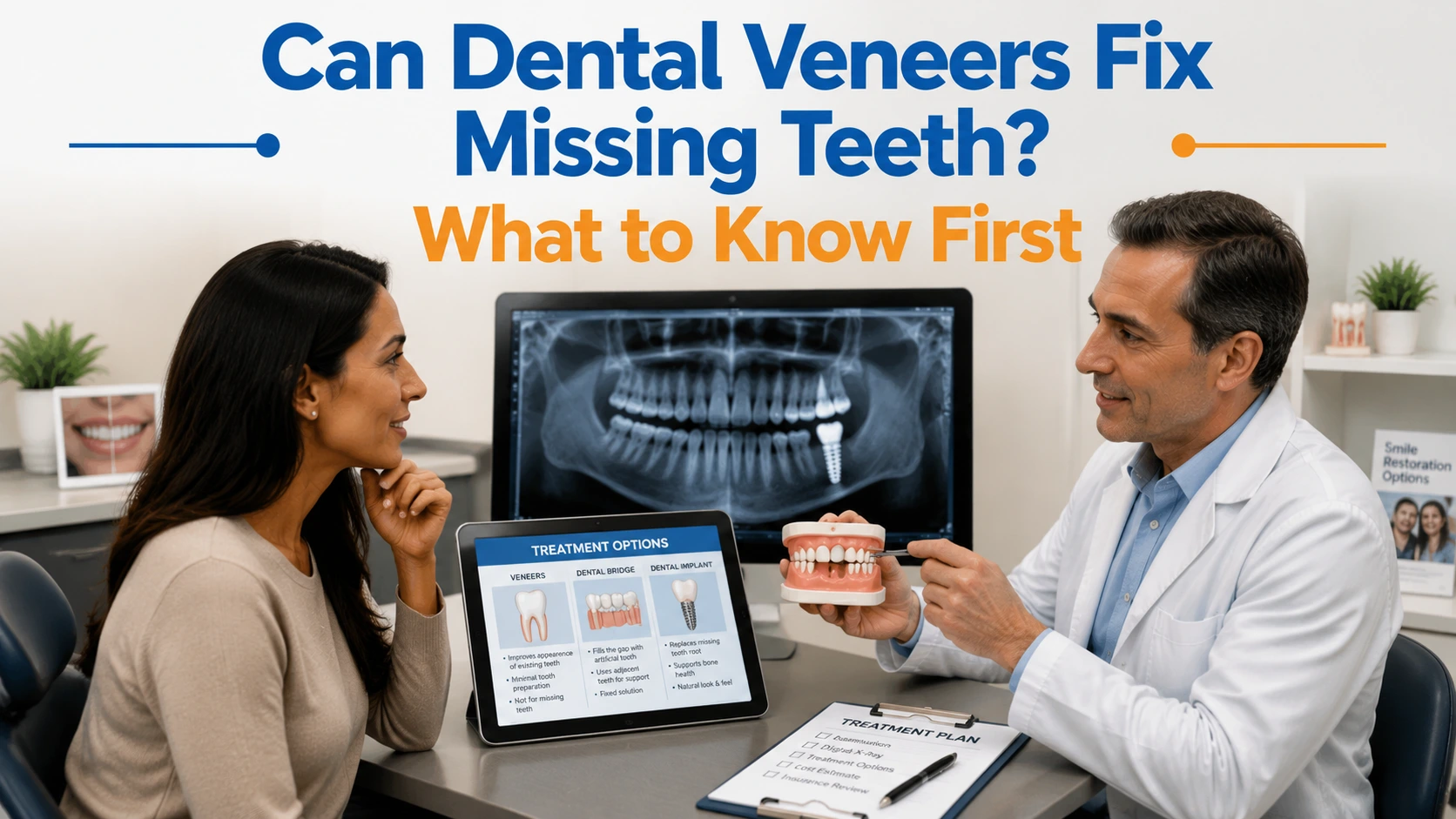
Losing a tooth can affect much more than your smile. Many people become self-conscious in photos, avoid certain foods, or wonder if a cosmetic treatment can restore their appearance without surgery.
If you've searched for dental veneers for missing teeth, you're probably asking whether veneers can fill the gap or if another treatment is needed.
The answer depends on what's actually missing. Veneers can improve the appearance of existing teeth, but they cannot replace a tooth that is completely gone.
Understanding that difference makes it much easier to choose the right treatment. This guide explains how veneers work, when they may still be part of your treatment plan, and which options are designed to replace missing teeth.
Can Dental Veneers Replace Missing Teeth?
Traditional dental veneers cannot replace a missing tooth because they must bond to a healthy natural tooth. When an entire tooth is absent, there is no enamel available to support the veneer.
This is one of the biggest misunderstandings in cosmetic dentistry. Many people see a space and assume veneers can simply cover it. In reality, veneers improve existing teeth, while implants, bridges, and partial dentures replace teeth that are no longer there.
A Simple Way to Understand the Difference
• If the tooth is still present but chipped, stained, worn, or uneven, a veneer may help.
• If the entire tooth is missing, a replacement treatment is usually needed.
• If you have both cosmetic concerns and a missing tooth, veneers may be combined with another restorative treatment.
Knowing whether your goal is to repair a tooth or replace one is the first step toward choosing the right solution.
What Makes a Tooth Suitable for a Veneer?
A veneer depends on a healthy foundation. Before recommending treatment, a dentist checks whether enough strong tooth structure remains to support long-term bonding.
Your Dentist Will Evaluate
• Healthy tooth enamel
• Good gum health
• A stable bite
• Minimal untreated decay
• No severe teeth grinding without protection
People often focus only on the visible front of the tooth, but dentists also evaluate how the upper and lower teeth meet. Heavy bite pressure or untreated grinding can shorten the lifespan of cosmetic restorations if they are not managed properly.
Another point many patients overlook is that a broken tooth and a missing tooth are not the same condition. Even when a large portion of a tooth has fractured, it may still be restored with a crown or another treatment instead of being replaced entirely.
How Do Dental Veneers Work?
Dental veneers are thin, custom-made coverings that improve the front surface of existing teeth. They can change a tooth's color, shape, size, and overall appearance while preserving much of the natural tooth underneath.
Veneers Are Commonly Recommended For
• Chipped teeth
• Deep staining that whitening cannot correct
• Worn edges
• Uneven tooth shapes
• Small gaps between teeth
• Mild cosmetic alignment concerns
Porcelain Veneers
Porcelain veneers are crafted in a dental laboratory and are known for their lifelike appearance and stain resistance. They are often chosen when long-term cosmetic improvement is the goal.
Composite Resin Veneers
Composite resin veneers are created with tooth-colored resin shaped directly on the tooth. They generally require less preparation and can often be repaired more easily if chipped.
Both materials require healthy tooth structure underneath. Neither is designed to replace a missing tooth or function as a bridge across a space.
Can You Get Veneers With Missing Teeth?
Yes, but only under the right circumstances.
If one tooth is missing while the surrounding teeth have cosmetic concerns, veneers may still be included in your overall treatment plan.
For example, a missing front tooth may be replaced with a dental implant and crown. Veneers can then improve the neighboring teeth so the entire smile looks balanced in color, size, and shape.
The same approach may be used alongside a dental bridge when nearby teeth also need cosmetic improvement.
One detail that many patients never hear about is color planning. Dental restorations do not respond to whitening treatments like natural teeth. If you plan to whiten your smile, it is usually best to complete whitening before your final veneer or crown shade is selected.
Which Treatments Replace Missing Teeth?
When a tooth has been lost, dentists usually recommend one of several restorative treatments based on your oral health, bone support, bite, and long-term goals.
Dental Implants
Dental implants replace both the missing tooth and its supporting root structure.
A complete implant restoration usually includes:
• Implant placed in the jawbone
• Abutment connecting the restoration
• Custom dental crown
Implants are often recommended because they function like natural teeth and do not depend on neighboring teeth for support.
Some patients may need bone grafting before implant placement if there is not enough healthy bone.
Dental Bridges
A dental bridge fills the space by using nearby teeth or implants for support.
The replacement tooth in the middle is called a pontic.
Bridges may be an excellent option when adjacent teeth already need crowns. If those neighboring teeth are completely healthy, your dentist will discuss whether preserving them or choosing an implant is the better long-term option.
Partial Dentures
A removable partial denture replaces one or several missing teeth and is removed for cleaning.
It restores more chewing function than cosmetic removable veneers and can be a practical option for some patients.
Are Snap-On, Pop-On, or Removable Veneers Worth Considering?
Snap-on, pop-on, clip-on, and other removable veneers are designed to improve appearance temporarily. They can hide stains, uneven teeth, or some gaps while they are being worn.
However, they should not be confused with permanent dental treatment.
They Do Not
• Replace missing tooth roots
• Prevent changes in the jawbone
• Restore normal chewing function
• Treat decay or gum disease
A poor fit may affect speech, trap food, or place unnecessary pressure on the gums.
Many online products are sold without a complete dental examination. Covering up a cosmetic concern without identifying its cause may allow dental problems to progress unnoticed.
Can You Eat With Pop-On Veneers?
Some removable appliances are designed to tolerate light eating, while others should always be removed before meals.
Always follow the manufacturer's instructions or your dentist's advice.
Hard, sticky, or chewy foods may damage the appliance or reduce its fit over time.
Veneers vs. Implants vs. Bridges
Treatment: Veneers
Best For: Improving existing teeth
Replaces a Missing Tooth: No
Type: Fixed
Treatment: Dental Implant
Best For: Replacing one missing tooth
Replaces a Missing Tooth: Yes
Type: Fixed
Treatment: Dental Bridge
Best For: Replacing one or more missing teeth
Replaces a Missing Tooth: Yes
Type: Fixed
Treatment: Partial Denture
Best For: Replacing multiple missing teeth
Replaces a Missing Tooth: Yes
Type: Removable
Treatment: Removable Veneers
Best For: Temporary cosmetic improvement
Replaces a Missing Tooth: No
Type: Removable
Choosing between these treatments is not about which option is newest or least expensive. It is about matching the treatment to the condition being treated.
A cosmetic concern usually calls for cosmetic treatment. A missing tooth requires tooth replacement.
How Much Do Teeth Veneers Cost?
If you're researching how much teeth veneers cost, remember that the final price depends on several factors rather than a single standard fee.
Cost Depends On
• Porcelain or composite material
• Number of veneers
• Smile design complexity
• Tooth preparation
• Laboratory work
• Additional restorative procedures
Replacing a missing tooth may involve separate costs for imaging, implant surgery, bone grafting, temporary restorations, or bridge fabrication.
Rather than comparing treatments based solely on starting price, consider expected longevity, maintenance, future repairs, and overall oral health.
How to Choose a Cosmetic Dentist for Veneers?
An experienced cosmetic dentist who specializes in veneers looks beyond appearance.
The evaluation should include:
• Tooth structure
• Gum health
• Bite alignment
• Available space
• Condition of neighboring teeth
Questions to Ask
• Which veneer material is best for me?
• How much experience do you have with smile makeovers?
• Do you also provide implant and bridge treatment?
• Can I see a digital smile preview?
• What maintenance will veneers require?
• What long-term results can I expect?
For patients with missing teeth, coordinated planning between cosmetic and restorative treatment often produces the most natural-looking results.
FAQ's
Can veneers replace one missing front tooth?
No. A veneer needs an existing tooth for support. Missing front teeth are typically replaced with an implant, bridge, or removable partial denture.
Can veneers close a large gap?
Small gaps between healthy teeth may sometimes be improved with veneers. A true missing-tooth space usually requires a replacement restoration instead.
What is the cheapest way to replace one missing tooth?
A removable partial denture often has the lowest starting cost, but the best option depends on comfort, function, maintenance, and long-term goals.
Do removable veneers stop bone loss?
No. Removable veneers improve appearance only. They do not replace the missing tooth root or provide stimulation to the jawbone.
Can veneers be placed after a dental implant?
Yes. Veneers may improve the appearance of nearby natural teeth after an implant restores the missing tooth, creating a more balanced smile.
Will insurance pay for veneers?
Cosmetic veneers are often not covered, while medically necessary restorative treatment may receive partial benefits depending on your insurance plan.
Choosing the Right Treatment Starts With the Right Diagnosis
The best cosmetic result begins with understanding the cause of the problem—not simply covering the space.
A careful dental examination can determine whether your smile needs cosmetic enhancement, tooth replacement, or both.
That approach helps create results that not only look natural but also support comfortable function and long-term oral health.