
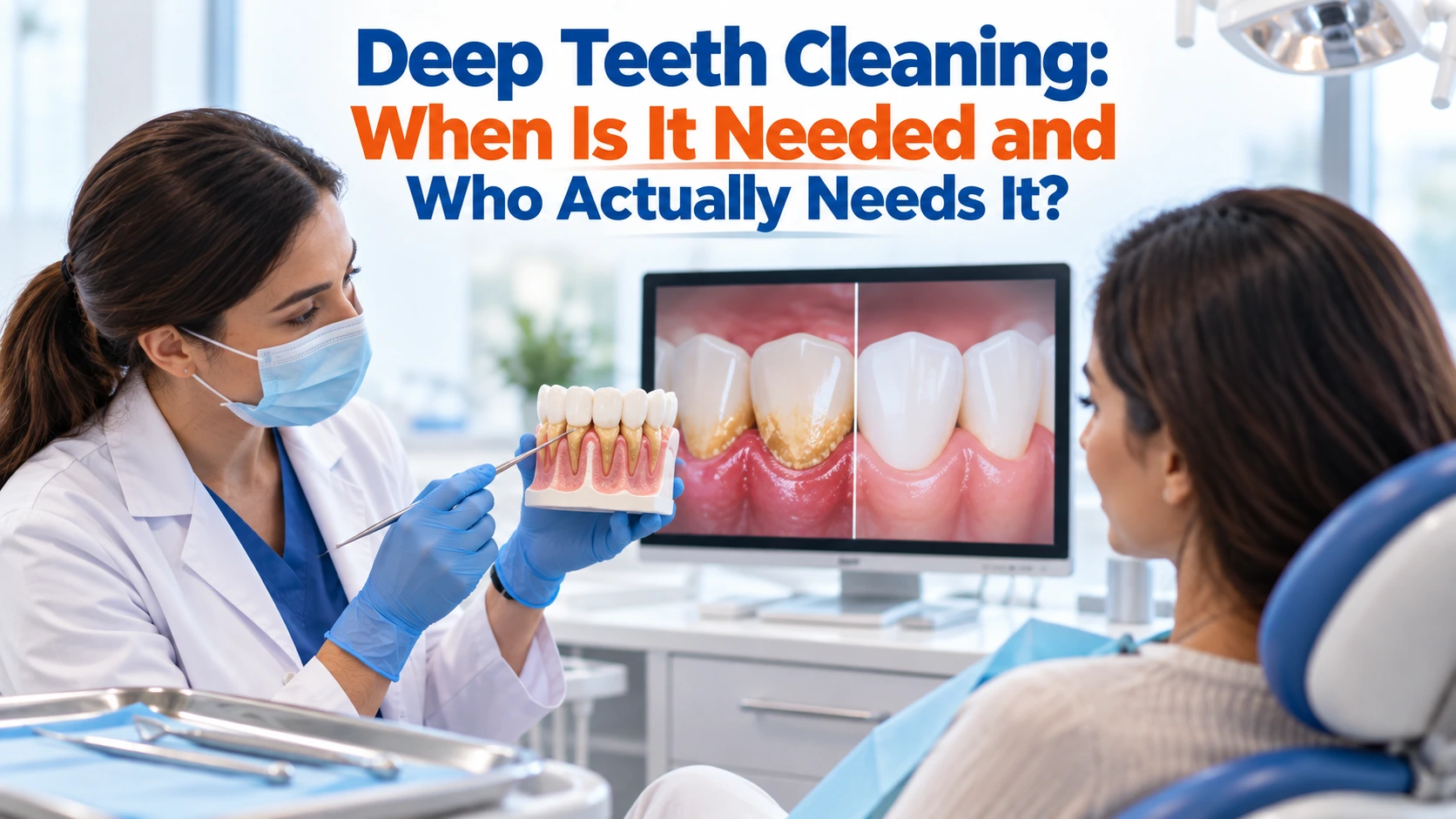
You may go to the dentist expecting a routine cleaning and suddenly hear, “You need a deep cleaning.” That can be confusing, especially if your teeth feel fine or you only notice mild bleeding when brushing.
Deep teeth cleaning is not simply a stronger version of a regular dental cleaning. It is a treatment used when gum disease has affected areas below the gumline. Your dentist should base the recommendation on a full periodontal exam, not one symptom or one pocket measurement.
Understanding what dentists look for can make the treatment decision much easier.
What Is Deep Teeth Cleaning?
Deep teeth cleaning is clinically called scaling and root planing (SRP). It is a nonsurgical treatment commonly used for periodontitis.
During scaling, the dentist or hygienist removes plaque and hardened tartar, also called calculus, from above and below the gumline. Root planing focuses on cleaning the root surfaces inside affected periodontal pockets.
The goal is not simply to make the teeth cleaner. Treatment aims to control periodontal disease and make the area easier to keep healthy at home.
Who Actually Needs a Deep Teeth Cleaning?
A dentist usually recommends deep cleaning when an exam shows signs of periodontal disease below the gumline.
The decision may involve several findings:
- Periodontal pocket depth around the teeth
- Bleeding or inflammation during periodontal probing
- Tartar below the gumline, known as subgingival calculus
- Loss of gum attachment around teeth
- Bone changes seen on dental X-rays
- The location and extent of periodontal disease
Smoking, diabetes, medical history, and home-care habits may also affect periodontal risk and how well the gums respond to treatment.
One finding alone does not always tell the full story. Dentists interpret these signs together before deciding whether scaling and root planing is appropriate.
Does a 4 mm Gum Pocket Mean You Need Deep Cleaning?
A 4 mm periodontal pocket does not automatically mean every tooth needs deep cleaning. Pocket depth is one part of a periodontal evaluation, not the entire diagnosis.
During periodontal charting, you may hear your hygienist call out numbers such as “3,” “4,” “5,” or “6.” These numbers describe the depth of the space between the tooth and gum.
When readings are deeper, the dentist also considers bleeding, attachment loss, tartar below the gums, X-ray findings, and whether the disease affects one area or several.
That distinction matters because two patients with the same deepest pocket measurement may have very different periodontal conditions.
Regular Cleaning vs Deep Cleaning: What Is the Difference?
A routine cleaning is mainly preventive. Scaling and root planing treats periodontal disease.
Factor |
Regular Cleaning |
Deep Cleaning |
| Main purpose | Prevent dental buildup and maintain gum health | Treat periodontal disease |
| Cleaning area | Mainly around and above the gumline | Above and below the gumline |
| Typical patient | Generally healthy supporting tissues | Periodontal disease is present |
| Root surfaces | Usually not treated deeply | Root surfaces are cleaned |
| Local anesthetic | Usually not required | May be used |
| Follow-up | Routine preventive visits | Periodontal reevaluation may be needed |
Another important point is that heavy tartar alone does not always mean someone has periodontitis. The dentist also needs to assess the health of the tissues and bone supporting the teeth.
Does Deep Teeth Cleaning Hurt?
Deep cleaning should be manageable for most patients. The dentist may use local anesthetic when deeper periodontal pockets or sensitive areas need treatment.
After the procedure, the gums can feel tender. Some people also notice temporary tooth sensitivity, mild bleeding, or soreness for a few days.
How your mouth feels afterward depends on the amount of inflammation, the depth of the pockets, the number of areas treated, and your natural sensitivity.
If you are wondering, “Does deep cleaning on teeth hurt?”, ask your dentist what type of numbing will be used and what discomfort you can reasonably expect afterward.
What Are the Disadvantages of Deep Cleaning Teeth?
Scaling and root planing can help control periodontal disease, but it may have temporary downsides.
Possible disadvantages include:
- Temporary tooth sensitivity
- Tender or sore gums
- Mild bleeding after treatment
- More visible spaces between some teeth
- Several appointments when larger areas need treatment
- Ongoing periodontal maintenance after treatment
Some patients worry that deep cleaning causes gum recession because their teeth may look slightly longer afterward.
Often, swollen gum tissue becomes smaller as inflammation improves. This can reveal more of the tooth or root surface and make spaces between teeth easier to see. The change can be surprising, but it does not necessarily mean the treatment damaged the gums.
Who May Not Need Scaling and Root Planing?
People with healthy gums and healthy supporting bone generally do not need scaling and root planing just because they want a more thorough cleaning.
Bleeding gums also don't automatically mean periodontitis. Gingivitis can cause redness, swelling, and bleeding without the attachment or bone loss seen with periodontitis.
That is why bleeding should prompt an evaluation rather than an automatic deep-cleaning recommendation.
If the reason for SRP is unclear, ask your dentist which periodontal findings led to the diagnosis.
What Happens If Periodontitis Is Not Treated?
Periodontitis affects the tissues and bone that support the teeth. As periodontal pockets deepen, they become harder to clean with brushing and flossing alone.
Without appropriate care, disease may lead to:
- Continued attachment loss
- More bone loss
- Gum recession
- Loose or shifting teeth
- Tooth loss in advanced cases
Periodontal treatment aims to control disease before more supporting tissue is lost.
What Happens After Deep Teeth Cleaning?
A periodontal reevaluation usually follows deep cleaning after the tissues have had time to respond.
Your dentist may check pocket depths again, look for bleeding, and assess areas that have not healed as expected.
Some patients then move to periodontal maintenance rather than returning to the same schedule as someone with healthy gums. These visits help control plaque and tartar after periodontal therapy.
Daily brushing and interproximal cleaning remain important because professional treatment cannot replace consistent home care.
Questions to Ask Before Deep Cleaning
Before treatment, you should understand what your dentist found and why they recommended SRP.
Consider asking:
- What are my periodontal pocket measurements?
- Did my gums bleed during probing?
- Is there attachment loss?
- Do my X-rays show bone loss?
- Which teeth or areas need treatment?
- Are any recommended procedures optional add-ons?
- When will my gums be reevaluated?
A clear explanation should help you understand the diagnosis, so you don't feel you have to accept treatment you don't understand.
FAQs
Can I have a regular cleaning instead of deep cleaning?
If periodontitis is present, a routine cleaning may not reach the plaque and calculus inside deeper periodontal pockets. The correct treatment depends on your periodontal diagnosis.
Can deep cleaning make teeth loose?
Deep cleaning does not normally cause loss of tooth support. Teeth affected by advanced periodontitis may already have reduced bone or attachment, which can become more noticeable after you treat the inflammation.
Can deep cleaning be done in one visit?
Sometimes. Larger treatment areas may be divided into two or more visits so each part of the mouth can be treated carefully.
Should I get a second opinion?
If you remain unsure about the diagnosis or treatment plan, you can ask another dentist or periodontist to review your periodontal chart, examination, and X-rays.
Understand Why Treatment Is Being Recommended
The most useful question before deep cleaning is not simply, “Do my gums bleed?” It is, “What findings show that I have periodontal disease that needs treatment?”
If you have been advised to get scaling and root planing, ask to review your periodontal measurements and X-rays. If you need a gum health evaluation in Issaquah, Eastside Modern Dentistry can assess your periodontal condition and explain the treatment options based on what the exam shows.