
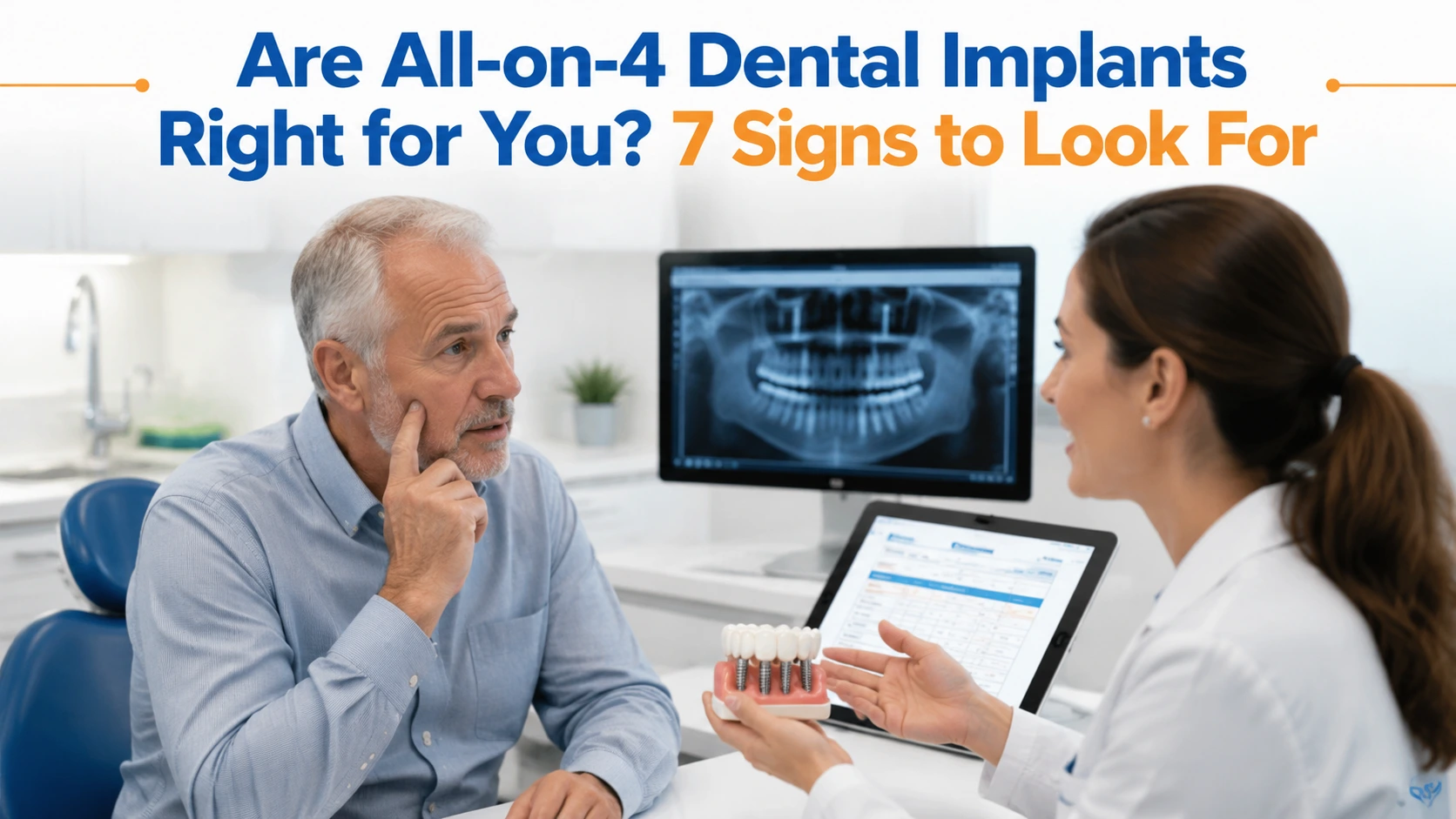
Missing most of your teeth can affect far more than your smile. Many people begin avoiding certain foods, feel uncomfortable speaking in public, or struggle with loose dentures that no longer fit well. When this happens, it's natural to look for a long-term solution that feels stable and looks natural.
All-on-4 dental implants are designed for people who need to replace most or all of the teeth in one jaw with a fixed set of replacement teeth. While this treatment has helped many patients regain function and confidence, it is not automatically the best option for everyone. Your oral health, jawbone condition, remaining teeth, and long-term goals all play important roles in determining whether this treatment is right for you.
This guide explains the seven signs that may indicate you're a good candidate, along with important cost considerations, insurance information, and practical questions to discuss with your dentist.
What Are All-on-4 Dental Implants?
All-on-4 is a full-arch tooth replacement technique that uses four carefully positioned dental implants to support a fixed bridge. Instead of replacing every missing tooth with its own implant, four implants work together to hold an entire row of replacement teeth securely in place.
One detail many patients overlook is that the implants and the bridge are two separate parts of the treatment. The implants act as artificial tooth roots, while the bridge is the visible set of teeth attached after surgery. In many cases, a temporary bridge is placed first while the implants heal and bond with the jawbone through a process called osseointegration. The permanent bridge is typically fitted once healing is complete.
7 Signs All-on-4 May Be Right for You
1. Most of Your Teeth Are Missing or Beyond Repair
All-on-4 is commonly recommended when several teeth in one jaw are already missing or have extensive decay, severe gum disease, repeated fractures, or other problems that make long-term restoration unlikely.
A common misconception is that damaged teeth always need to be removed. An experienced dentist should evaluate every remaining tooth individually because some can still be preserved with crowns, root canal treatment, or periodontal care. Saving healthy teeth whenever possible usually leads to better long-term oral health.
2. Your Dentures No Longer Feel Stable
Loose dentures can make eating, laughing, and speaking frustrating. As the jawbone naturally shrinks after tooth loss, dentures often become less secure and require frequent adjustments or adhesives.
Because All-on-4 bridges are attached to implants rather than resting directly on the gums, they generally provide greater stability during daily activities. However, they still require regular professional maintenance and careful cleaning beneath the bridge.
3. Dental Problems Affect the Entire Arch
When nearly every tooth in one arch has significant damage, treating each tooth separately may become less predictable and more expensive over time.
Instead of focusing only on today's dental problems, dentists also consider the long-term outlook of the entire arch. If multiple teeth have poor prognoses, a full-arch restoration may provide a more predictable solution than repeated repairs.
4. You Want a Fixed Solution Instead of Removable Teeth
Some patients want replacement teeth that stay in place throughout the day. A fixed bridge eliminates the need to remove dentures at night and avoids relying on adhesives for retention.
Even so, fixed teeth should never be viewed as maintenance-free. Daily cleaning with specialized brushes or water flossers and routine dental visits remain essential for protecting both the implants and surrounding gums.
5. Your Bone and Overall Health Support Implant Treatment
Healthy implants depend on more than having missing teeth. Before recommending All-on-4, your dentist will evaluate your jawbone with a CBCT scan, examine your gum health, review your medical history, and assess your bite.
Some people assume bone grafting is always required, while others believe All-on-4 never needs grafting. Neither is completely true. The angled placement of the back implants often allows dentists to use available bone more efficiently. However, some patients may still benefit from additional bone-building procedures depending on their anatomy.
Medical conditions such as uncontrolled diabetes, heavy smoking, untreated gum disease, or certain medications can also affect healing. These factors do not automatically rule out treatment, but they should be managed before implant surgery whenever possible.
6. You Can Commit to Long-Term Care
Choosing All-on-4 is a long-term commitment rather than a one-time procedure. The first few weeks usually involve softer foods while the implants heal, followed by regular follow-up appointments to monitor progress.
Patients who enjoy the best long-term outcomes typically:
- Maintain excellent daily oral hygiene.
- Attend routine professional maintenance visits.
- Follow dietary recommendations during healing.
- Wear a night guard if they grind or clench their teeth.
- Report unusual movement, swelling, or discomfort promptly.
One overlooked point is that while implants cannot develop cavities, the surrounding gums and supporting bone can still become inflamed. Regular maintenance helps reduce the risk of peri-implant disease, which can affect implant health over time.
7. You Understand the Full Cost of Treatment
Cost is often one of the biggest deciding factors.
The price of All-on-4 dental implants depends on several variables, including:
- Whether one or both arches are being treated.
- Tooth extractions.
- CBCT imaging and digital treatment planning.
- Sedation.
- Bone grafting, if needed.
- Temporary teeth.
- Final bridge material.
- Follow-up care and maintenance.
Rather than comparing advertisements alone, think about three different costs:
- The advertised starting price.
- The complete treatment fee, including surgery and the final restoration.
- The long-term ownership cost, such as professional maintenance, repairs, replacement components, or a future bridge replacement if necessary.
Understanding all three gives a much more accurate picture of your investment.
How Are All-on-4 Implants Different From Traditional Dentures?
Both treatments replace missing teeth, but they function differently.
Feature |
All-on-4 Dental Implants |
Traditional Dentures |
Stability |
Fixed securely to dental implants |
Rests directly on the gums |
Removal |
Removed only by a dental professional |
Removed daily by the patient |
Chewing Ability |
Usually provides stronger, more stable biting force |
May shift or move while chewing |
Jawbone Support |
Helps stimulate the jawbone and slow bone loss |
Does not stimulate the jawbone, so bone loss continues over time |
Daily Care |
Requires cleaning beneath the fixed bridge |
Must be removed and cleaned separately each day |
What Should a Dental Implant Cost Calculator Include?
Online cost calculators can provide a helpful starting estimate, but they cannot replace a professional examination.
A meaningful estimate should consider:
- One or both arches.
- Number of extractions.
- Bone grafting needs.
- Sedation.
- Temporary and final prosthesis.
- Insurance contribution.
- Financing options.
Without clinical findings and three-dimensional imaging, any online estimate remains only an approximation.
Does Insurance Cover All-on-4 Dental Implants?
Insurance coverage varies widely between plans. Some policies may contribute toward examinations, imaging, extractions, or parts of the restoration, while implant components themselves may have limited or no coverage.
Ask your dental office for a written pre-treatment estimate so you understand your expected benefits before treatment begins. If additional financial support is needed, financing plans, Health Savings Accounts (HSA), or Flexible Spending Accounts (FSA) may also help manage out-of-pocket costs.
FAQ's
Can I get All-on-4 if I have bone loss?
Many patients with moderate bone loss still qualify, but the amount and location of bone must be evaluated with a CBCT scan.
Are the teeth placed on surgery day permanent?
Usually not. Most patients wear a temporary bridge during healing before receiving their final restoration.
Can All-on-4 implants fail?
Although implant success rates are high, smoking, uncontrolled gum disease, poor oral hygiene, certain medical conditions, and excessive bite forces can increase the risk of complications.
How do I know if All-on-4 is the right choice?
The best decision comes from a comprehensive examination that evaluates your remaining teeth, bone quality, bite, medical history, and long-term treatment goals—not from cost alone.
Conclusion
Choosing All-on-4 is about more than replacing missing teeth. It is about selecting a treatment that fits your long-term oral health, daily lifestyle, and future expectations. A thorough evaluation can determine whether preserving natural teeth, using another implant solution, or moving forward with All-on-4 offers the most predictable outcome for your smile.