
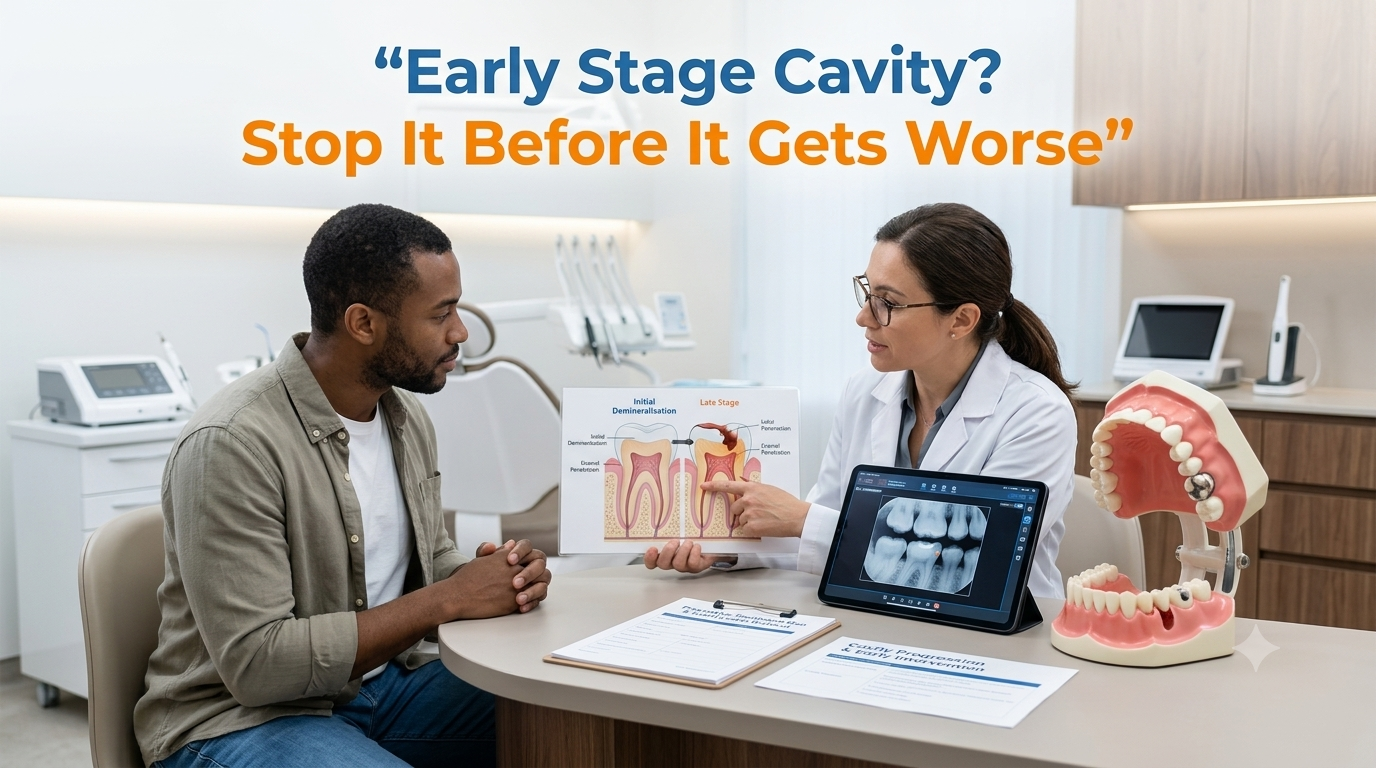
What Is an Early-Stage Cavity?
An early-stage cavity is the earliest stage of tooth decay, before permanent damage occurs. It starts when acids produced by bacteria in the mouth cavity weaken the enamel, the tooth's hard outer layer.
Many people assume cavities appear suddenly, but tooth decay develops gradually. Before a cavity forms, the enamel undergoes a process called demineralization, in which important minerals such as calcium and phosphate are lost.
One of the earliest warning signs is a white spot lesion. This appears as a chalky white area on the tooth and often indicates that decay has begun.
In clinical practice, Dr. Jaggi frequently sees patients who are surprised to learn they have early decay because the affected tooth feels completely normal. This is one reason regular dental exams are so important.
What Does an Early Cavity Look Like?
An early cavity often looks very different from the dark hole many people picture when they think about tooth decay.
Common Signs of an Early Cavity
- White or chalky spots on teeth
- Brown or dark discoloration
- Rough enamel surfaces
- Mild tooth sensitivity
- Food frequently gets trapped in one area
- Changes near the gumline
A common real-world example is a patient noticing a small white spot near the gumline while brushing. Many people assume it is harmless staining. However, that white spot may actually represent the earliest stage of enamel damage.
Why Do Early Cavities Appear White?
This is a detail many dental articles overlook.
White spots develop because minerals are being lost beneath the enamel surface. As the enamel structure changes, light reflects differently, creating the chalky appearance.
What Causes Cavities to Develop?
Cavities form when bacteria within dental plaque, also known as dental biofilm, produce acids that attack tooth enamel.
Every time you consume sugary or starchy foods, bacteria in your oral cavity feed on those carbohydrates and create acid. Repeated acid attacks gradually weaken enamel and increase the risk of decay.
Common Risk Factors
| Risk Factor | Why It Matters |
| Frequent sugar consumption | feeds harmful bacteria |
| Poor oral hygiene | allows plaque buildup |
| Dry mouth | reduces saliva protection |
| Lack of fluoride | weakens enamel defense |
| Frequent snacking | increases acid attacks |
| Orthodontic appliances | can trap plaque |
The Important Role of Saliva
Saliva is one of the body's natural defenses against tooth decay. It helps wash away food particles, neutralize acids, and support remineralization.
People with dry mouths often develop cavities more quickly because this protective system is weakened.
What Are the Stages of Dental Decay?
The stages of dental decay progress from minor enamel changes to serious infections affecting the tooth's inner structures.
Dental Decay Stages at a Glance
The stages of dental decay include enamel demineralization, enamel breakdown, dentin decay, and pulp infection. Early stages may be reversible, while advanced stages typically require restorative dentistry treatments such as fillings, crowns, or root canal therapy.
| Stage | What Happens | Reversible? | Typical Treatment |
| Demineralization | Mineral loss in enamel | Often Yes | Fluoride, monitoring |
| Enamel Decay | Surface damage begins | Sometimes | Preventive care or filling |
| Dentin Decay | Decay reaches inner layer | No | Filling |
| Pulp Infection | Nerve affected | No | Root canal therapy |
Stage 1: Demineralization
The enamel loses minerals but remains structurally intact. White spot lesions commonly appear during this phase.
Stage 2: Enamel Decay
The enamel begins breaking down. Small cavities may start forming.
Stage 3: Dentin Decay
Once decay reaches dentin, progression becomes much faster because dentin is softer than enamel.
Stage 4: Pulp Infection
The deepest stage occurs when decay reaches the pulp, which contains nerves and blood vessels. Pain, swelling, and infection often develop.
Early Cavity vs Advanced Cavity
Understanding the difference can help patients seek care before more extensive treatment becomes necessary.
| Feature | Early Cavity | Advanced Cavity |
| Pain | Rare | Common |
| Visible Damage | Minimal | Significant |
| Reversible | Often | No |
| Treatment | Fluoride, monitoring | Filling, crown, root canal |
| Cost | Lower | Higher |
| Treatment Complexity | Simple | More involved |
Can You Reverse a Cavity Naturally?
Natural habits such as reducing sugar and improving oral hygiene can support remineralization. However, once a cavity creates a physical hole in the tooth, natural methods alone cannot repair the damage.
How Do Dentists Diagnose Early Tooth Decay?
Dentists use multiple methods to detect decay before symptoms become obvious.
Diagnostic Tools Include:
- Visual examination
- Dental explorers
- Digital X-rays
- Risk assessment
- Clinical evaluation
At Eastside Modern Dentistry, early detection is a priority because identifying decay sooner often allows for more conservative treatment options.
What Happens If You Ignore an Early Cavity?
An untreated cavity does not usually stop progressing on its own.
As decay advances, it can spread deeper into the tooth and eventually require more extensive restorative care.
Potential Consequences
- Increased tooth sensitivity
- Larger cavities
- Tooth pain
- Early dental abscess or infection
- Root canal treatment
- Tooth loss
One of the most common mistakes Dr. Jaggi sees is patients waiting until pain develops. Unfortunately, many cavities progress significantly before symptoms become noticeable.
Why Do Some Cavities Get Worse Faster?
Not all cavities progress at the same rate.
Factors that can accelerate tooth decay include:
- Dry mouth
- Frequent snacking
- High sugar diets
- Poor saliva quality
- Orthodontic appliances
- Inconsistent oral hygiene
Why Nighttime Habits Matter
Saliva production naturally decreases while sleeping. This means teeth have less protection against acid attacks overnight.
Going to bed without brushing can significantly increase cavity risk over time.
How Can You Prevent Cavities From Getting Worse?
Preventing cavity progression requires a combination of home care and professional dental treatment.
The STOP Framework
S – Spot Early Signs
Watch for white spots, sensitivity, or discoloration.
T – Track Changes
Monitor symptoms that become more noticeable over time.
O – Optimize Oral Hygiene
Brush twice daily, floss regularly, and use fluoride products.
P – Plan a Dental Visit
Seek professional evaluation before the problem progresses.
Additional Prevention Tips
- Brush twice daily with fluoride toothpaste
- Floss every day
- Limit sugary snacks
- Drink water frequently
- Visit your dentist regularly
- Ask about fluoride treatments and sealants
When Should You See a Dentist?
You should schedule a dental evaluation if you notice:
- White spots on teeth
- Tooth sensitivity
- Brown discoloration
- Food frequently gets stuck
- Changes in tooth appearance
- Persistent concerns about tooth decay
Early treatment is often simpler, less invasive, and less expensive than treating advanced decay.
At Eastside Modern Dentistry, patients benefit from comprehensive care under one roof, including restorative dentistry, oral surgery, endodontics, and implant services when needed.
Key Takeaways
- Early-stage cavities begin with enamel demineralization.
- White spot lesions are often the first visible sign.
- Some early cavities can be reversed through remineralization.
- Untreated decay can progress into dentin and eventually into the pulp.
- Saliva, fluoride, and good oral hygiene help protect teeth.
- Early diagnosis allows for more conservative treatment.
- Regular dental visits remain one of the best ways to prevent serious dental problems.
Frequently Asked Questions
What are the first signs of a cavity?
The earliest signs often include white spots, mild sensitivity, rough enamel, or subtle discoloration. Many early cavities do not cause pain.
Is a white spot always a cavity?
Not always. However, white spot lesions are commonly associated with early enamel demineralization and should be evaluated by a dentist.
Can fluoride reverse tooth decay?
Fluoride can help reverse early enamel demineralization before a cavity forms. It cannot repair advanced decay that has already created a hole in the tooth.
Do all cavities require fillings?
No. Very early lesions may respond to preventive care and remineralization. Once structural damage occurs, restorative treatment is typically necessary.
Conclusion
The early stages of a cavity are often easy to miss, but they present the best opportunity to protect your teeth and avoid more extensive treatment. Understanding the signs of tooth decay, recognizing its stages, and seeking professional care when concerns arise can make a significant difference in your long-term oral health.
If you notice white spots, sensitivity, or other signs of early decay, don't wait for pain to develop. A timely evaluation can help determine whether the damage is reversible or requires restorative treatment.
At Eastside Modern Dentistry, our team focuses on patient-centered care and early intervention to help preserve healthy smiles for years to come.